Branches hanging too close to the roof, limbs rubbing after wind, or a canopy that has grown uneven can turn a good-looking tree into a worry. If you are seeing deadwood, crowded growth, or branches reaching into drive paths and walkways, the next step is a careful trim that fits the tree, the site, and the season.
Edmonton Tree Service handles tree trimming and pruning for properties across Edmonton, Alberta T5H2S9, with attention to structure, clearance, and tree health. We look at the full tree before cutting, so the work supports better growth, reduced strain, and a cleaner yard without stripping the tree bare.
Tree trimming is not just about shortening branches. It is used to reduce rubbing limbs, improve shape, remove dead or declining wood, and create needed clearance from structures, fences, driveways, and utility conflicts. A thoughtful pruning cut can change how a tree grows over time, not just how it looks today.
Homeowners often call when a tree starts crowding a roofline, blocking sightlines, or dropping branches after a storm. Others want to correct poor structure before the tree becomes a larger concern. We assess the canopy, branch unions, trunk line, and overall form before deciding what should stay and what should come off.
Edmonton trees can show different pruning needs depending on species, age, location, and past care. A backyard maple with dense interior growth needs a different cut than a spruce with dead lower limbs or a crabapple with crossing shoots and weak attachment points.
We look for crowded stems, narrow branch angles, codominant leaders, included bark, and branches that compete for space. These features can increase future breakage or create weak structure if left alone.
We check for limbs reaching too close to homes, garages, walkways, parked vehicles, and neighboring properties. Clearance pruning can reduce contact points and keep access areas more usable.
Deadwood, cracks, decay, leaf loss, canopy dieback, and storm damage all affect pruning decisions. When a tree is already stressed, cuts need to be selective so the tree is not pushed further back.
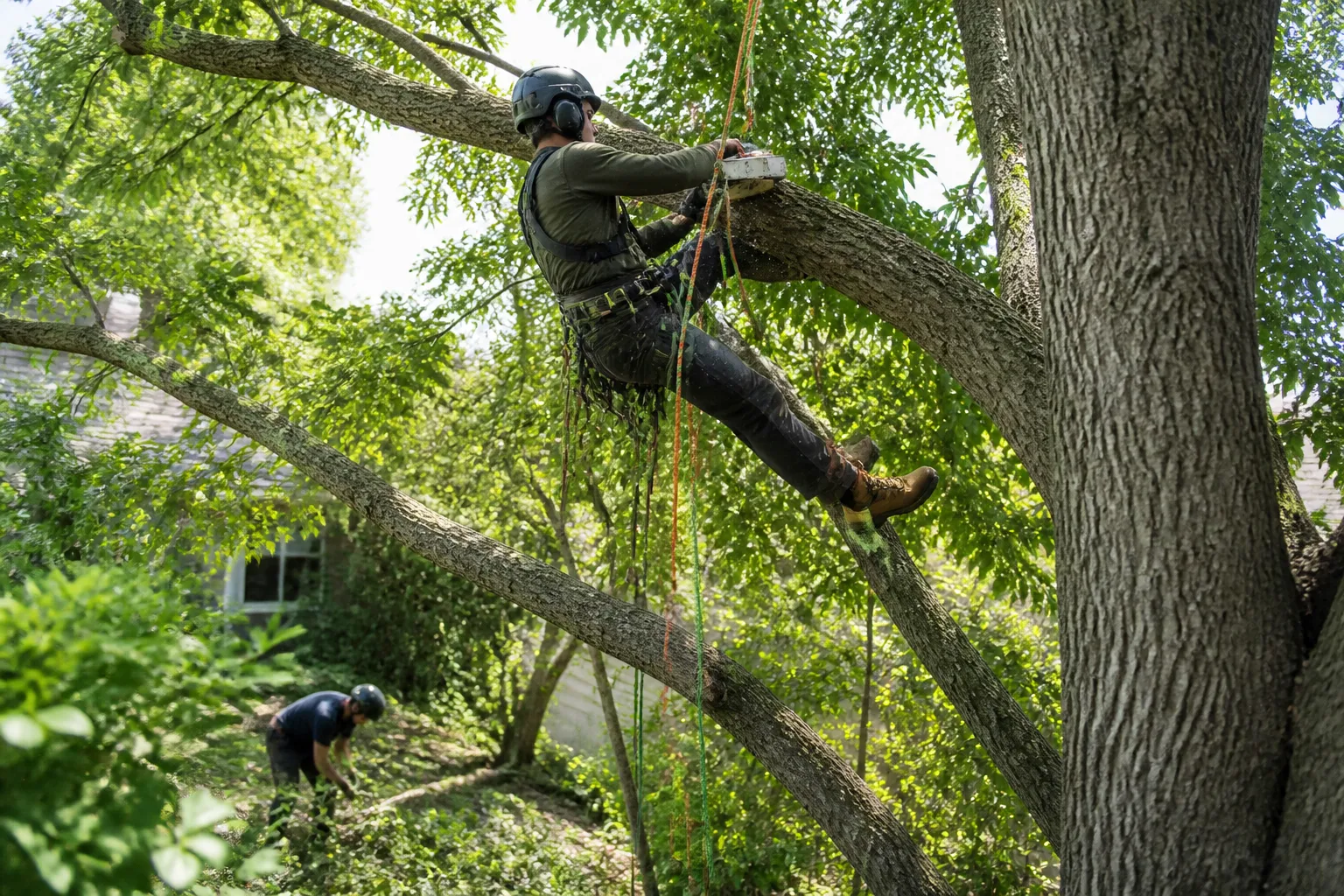
We use tree trimming methods that match the tree’s size, condition, and location. The goal is to remove only what is necessary while keeping the remaining canopy balanced. On larger trees, work may involve climbing systems, arborist ropes, controlled rigging, lowering devices, tag lines, chainsaws, and wood chippers when site access and branch size call for it.
Selective pruning removes specific branches rather than topping or flattening the canopy. This helps preserve the tree’s natural shape and reduces the stress caused by excessive removal.
Young and maturing trees can benefit from structure-focused pruning that guides branch spacing and stem development. This can reduce future problems with weak unions and crowded growth.
When branches interfere with access, visibility, or nearby structures, we trim to create practical space while keeping the tree’s shape as intact as possible.
Good pruning considers the whole tree, not just the visible branch tips. We pay attention to the root flare, root zone, trunk, scaffold branches, branch unions, and canopy because cuts at one point can affect how the tree responds elsewhere.
For trees showing disease, pest activity, or environmental stress, pruning may be part of a broader care plan. Signs such as bark abnormalities, fungal fruiting bodies, abnormal leaning, or heavy dieback can indicate that a tree needs more than a simple trim before work begins.
Different trees respond differently to trimming, and Edmonton properties often include a mix of American elm, green ash, Manitoba maple, trembling aspen, balsam poplar, spruce, pine, birch, crabapple, and mountain ash. Each has its own growth habits, limb strength, and pruning sensitivity.
American elm and other public-tree considerations may require extra care around timing, branch size, and pruning approach. Dense deciduous trees often need selective thinning and deadwood removal. Conifers usually need a lighter touch so the tree does not lose its natural form. We match the cut to the species rather than using one style for every tree.
If you are unsure whether pruning is needed, the tree often gives clear signals. These problems do not always mean the tree must be removed. In many cases, a focused trim can improve safety, structure, and appearance at the same time.
Limbs that scrape siding, roofs, gutters, or fences can cause wear and create access problems.
Dead limbs and broken stubs can fall without warning and should not be left hanging in the canopy.
When light barely reaches the middle of the tree, crowded branches may be competing too heavily for space.
Branches that move against each other can create open wounds and weaken attachment points.
A tree leaning visually to one side or carrying excess weight on one limb may benefit from targeted reduction.
Edmonton Tree Service begins with a look at the tree, its surroundings, and the type of pruning it actually needs. That may mean removing deadwood, opening crowded sections, creating clearance, or reducing long limbs that extend too far from the main structure. We work with an eye on tree health and property protection from start to finish.
Once the cutting is complete, debris is managed and the site is left ready for normal use. For larger branches and dense material, a chipper may be used to handle the volume more efficiently. If pruning reveals deeper structural problems, we can discuss whether the tree needs a different arboricultural approach.
Pruning becomes more important when a tree shows signs of disease, pests, or stress. Edmonton trees can be affected by Dutch elm disease, elm bark beetles, black knot, fungal pathogens, insect pests, drought, soil compaction, root disturbance, heavy snow, freeze-thaw cycles, and severe wind events. These pressures can leave the canopy thin, damaged, or uneven.
We examine symptoms such as chlorosis, leaf loss, abnormal bark changes, canopy dieback, and fungal growth before deciding how much to remove. When a tree is already under strain, the trim needs to be measured so it does not remove too much energy-producing foliage at once.
It depends on the tree species, age, growth rate, and location. Some trees need periodic structural pruning, while others only need attention when deadwood, crowding, or clearance concerns develop.
Yes. Selective cuts can improve balance, reduce awkward extension, and guide future growth while keeping the tree looking natural.
Dead branches are usually a priority because they do not contribute to the tree and can become brittle. The amount removed depends on where the deadwood sits and what else is happening in the canopy.
Yes. Mature trees often benefit from deadwood removal, branch reduction, and selective clearance work, especially when branches are close to structures or showing signs of stress.
It should. Good pruning keeps the natural outline of the tree while easing crowding and removing problem limbs rather than forcing a harsh shape.
Weak unions, codominant stems, and included bark can change how pruning is planned. The cut needs to support safer structure without creating unnecessary stress.
For tree trimming and pruning at Edmonton, Alberta T5H2S9, Edmonton Tree Service can help you make sense of what should stay, what should come off, and what the tree needs next. Whether the concern is clearance, deadwood, shape, or tree health, careful pruning can make a noticeable difference without overworking the tree.
Call +16477005472 to discuss the tree you are looking at and arrange a visit. Our office at 10967 101 Street, Edmonton, Alberta T5H2S9 is open daily from 7:00 to 21:00.
Get Started
Tell us what’s happening with your tree and property. Whether you’re dealing with storm damage, declining branches, a hazardous tree, stump removal or planned pruning, we’ll review the tree, site access and surrounding targets to help determine the appropriate next step.