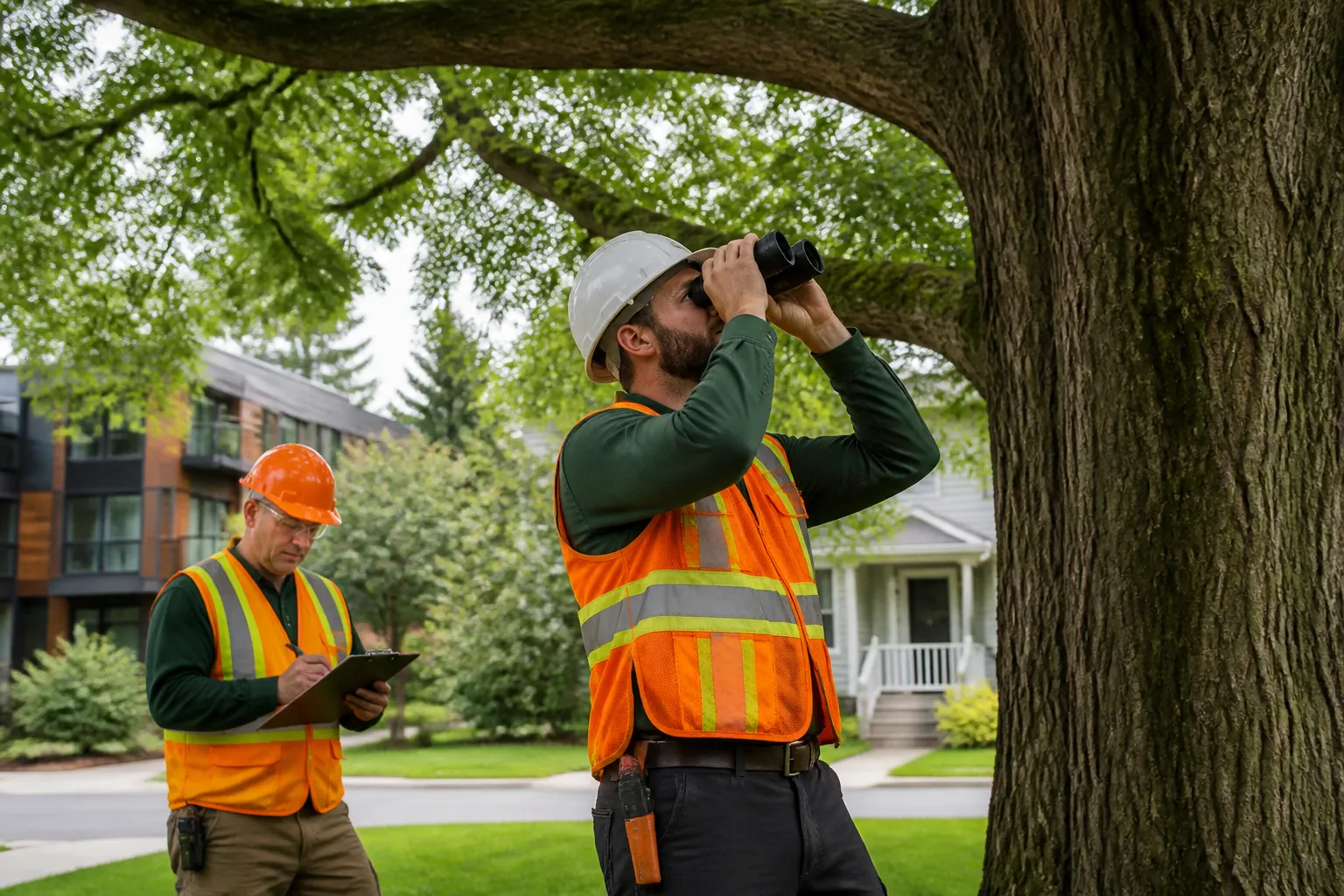
A tree that has started to lean, shed larger branches, or show cracking wood can move from a concern to a real hazard quickly. If you are noticing dead limbs, hollow areas, root disturbance, or a canopy that looks thinner than it used to, it is time to have the tree looked at before it affects people, property, or access on your site.
Edmonton Tree Service provides tree risk and hazard assessments for properties throughout Edmonton, Alberta T5H2S9. We look at the visible structure, the condition of the trunk and canopy, the root zone, and the site around the tree so you can make a practical decision based on what the tree is actually showing.
A risk assessment is not a quick glance from the curb. We evaluate the tree from the ground up, then consider how its condition interacts with the target area below and around it. That includes nearby homes, garages, walkways, vehicles, utility conflicts, and the amount of exposure the tree has to wind and weight shifts.
We also consider how the tree has been affected by pruning history, storm loading, nearby construction, root disturbance, and species-specific concerns that are common across Edmonton landscapes. A tree can look stable from a distance and still have a condition that needs attention once it is examined closely.
Some trees fail without much warning, but many show clues before the situation becomes more serious. The most common signs are easy to notice once you know what to look for.
Branches that no longer leaf out, or a portion of the canopy that stays bare while the rest of the tree is active, can point to decline or internal damage.
Long splits in the trunk, branch unions, or major limbs may indicate movement or weakness that should be assessed before failure occurs.
Cavities, soft areas, or fungal growth can be signs that structural wood has been compromised.
A tree that has shifted noticeably, especially with soil lifting at the base, may be responding to root failure or unstable ground conditions.
When most of the weight sits on one side, the tree can carry more stress during wind, snow, or frozen conditions.
Not every visible flaw means the tree must come down. Some conditions can be managed through pruning, cabling and bracing, or ongoing monitoring. The purpose of an assessment is to sort out which path makes sense for that specific tree and site.
When we arrive at a property, we begin by reviewing the tree from multiple angles and identifying what the tree is telling us through its structure, growth, and visible symptoms. We then connect those signs to the location of targets below the canopy and the consequences if a branch or the whole tree were to fail.
We look at the tree’s surroundings, including structures, fences, walk paths, drive access, and other trees that may influence wind exposure or recovery space.
We inspect trunk form, branch unions, canopy density, visible decay, bark condition, and root-related indicators. If the tree has been storm-stressed, diseased, or pruned heavily before, that history matters too.
After the inspection, we explain what is concerning, what appears stable, and what the likely options are. Those options may include pruning, cabling and bracing, disease and pest management, planting a replacement tree, or removal where the hazard is too great to manage another way.
Edmonton Tree Service keeps the discussion practical. You should be left with a clear understanding of what the tree needs now and what can wait.
Edmonton properties often include mature trees that have faced years of pruning, weather stress, disease pressure, or site changes around the root area. Certain problems come up again and again during assessments.
We also pay close attention to species commonly seen across Edmonton, including American elm, green ash, Manitoba maple, trembling aspen, balsam poplar, spruce, pine, birch, crabapple, and mountain ash. Different species show different failure patterns, and that changes how risk is judged.
An assessment is useful because it turns uncertainty into a plan. Once the tree’s condition is clearer, you can choose a response that fits the risk level and the tree’s value to the property.
If the main issue is weight, deadwood, or crowded structure, targeted tree pruning and trimming may reduce stress and improve clearance without removing the whole tree.
Where major stems or unions need support, tree cabling and bracing can help manage movement and reduce the chance of structural failure.
When the tree presents a serious hazard and cannot be made acceptably safe through other means, removal may be the right choice. For trees over structures or in tight spaces, the work may require sectional dismantling, controlled rigging, or crane-assisted tree removal.
Not every concern becomes a removal recommendation. The goal is to match the response to the actual condition of the tree, the site layout, and the target below.
Risk and health are closely connected. A tree under biological stress often loses some ability to compartmentalize wounds, support heavy limbs, or respond to environmental pressure. That is why assessment work often includes disease and pest observations, not just structural checks.
We look for symptoms such as canopy dieback, chlorosis, leaf loss, bark abnormalities, fungal fruiting bodies, and signs of insect activity. In Edmonton, issues such as Dutch elm disease, elm bark beetles, black knot, fungal pathogens, insect pests, drought stress, soil compaction, root disturbance, heavy snow, freeze-thaw cycles, and strong wind events can all change how a tree should be managed.
If the tree is stressed but still worth saving, management may focus on careful pruning, health improvement, or monitoring. If the stress is severe and the structure is failing, the assessment may point toward removal before a branch or trunk section breaks under load.
Tree risk concerns are not limited to one type of site. Homeowners, property managers, businesses, and commercial properties all face different target conditions, which means the same tree can present a different level of concern depending on where it stands.
On a residential lot, the main concern may be a tree near a roofline, driveway, or rear yard access. On a larger property, the concern may involve walk paths, parked vehicles, loading areas, or clusters of trees with overlapping canopies. Boulevard and public trees may also require special attention because of nearby utility conflicts and City of Edmonton Urban Forestry considerations.
If you are unsure whether a tree is a true hazard or just showing age, an assessment gives you a grounded answer instead of a guess.
It looks at the tree’s structure, root zone, trunk, branches, canopy, visible defects, and the area around it where damage could occur if something failed.
Yes. A full canopy does not rule out internal decay, weak unions, root movement, or heavy limbs that could fail under stress.
No. Some trees have a stable natural lean, while others show a new or worsening lean tied to root or soil movement. The cause matters more than the angle alone.
Yes, if the main issue is deadwood, imbalance, or excess weight. Pruning can sometimes lower risk without removing the tree.
We pay close attention to the target area, then consider whether pruning, support, or removal is the safest path based on the tree’s condition and available work space.
As soon as you notice cracking, sudden lean, large dead sections, or movement at the base. Early assessment gives more options for managing the tree.
If a tree on your property is showing signs of stress, weakness, or structural change, Edmonton Tree Service can assess it at your Edmonton, Alberta T5H2S9 location and explain what the findings mean for your property. We work with a clear focus on tree structure, site targets, and practical next steps.
Call +16477005472 to schedule a tree risk and hazard assessment for your home, business, or managed property. Our address is 10967 101 Street, Edmonton, Alberta T5H2S9.
Get Started
Tell us what’s happening with your tree and property. Whether you’re dealing with storm damage, declining branches, a hazardous tree, stump removal or planned pruning, we’ll review the tree, site access and surrounding targets to help determine the appropriate next step.