A leaning trunk, cracked limb, or tree crowding a structure can turn a normal yard into a stressful one fast. When a tree is no longer safe to keep, the next step is a clear removal plan that protects the property and keeps the work controlled from start to finish.
Edmonton Tree Service handles tree removal for homes, businesses, property managers, and commercial properties at 10967 101 Street, Edmonton, Alberta T5H2S9. We assess the tree, the space around it, and the safest method for taking it down, whether that means sectional dismantling, directional felling, or crane-assisted removal for larger or more complex jobs.
Not every problem tree needs to come down, but some do. We look at the tree structure, the surrounding targets, and the condition of the root zone before recommending removal. If a tree has a serious defect or no longer fits the site, taking it out can prevent further damage and reduce ongoing risk.
Common reasons homeowners request tree removal include dead or declining trees, trunks with major decay, stems with large cracks, trees leaning into structures, and trees that have outgrown their space. We also remove trees that interfere with planned construction, access, or property use.
Different trees call for different methods. A small open-grown tree may be removed with directional felling, while a tree near a house, fence, garage, or utility conflict may need to be dismantled in sections. The method depends on the available drop zone, the size and condition of the tree, and what sits below and around it.
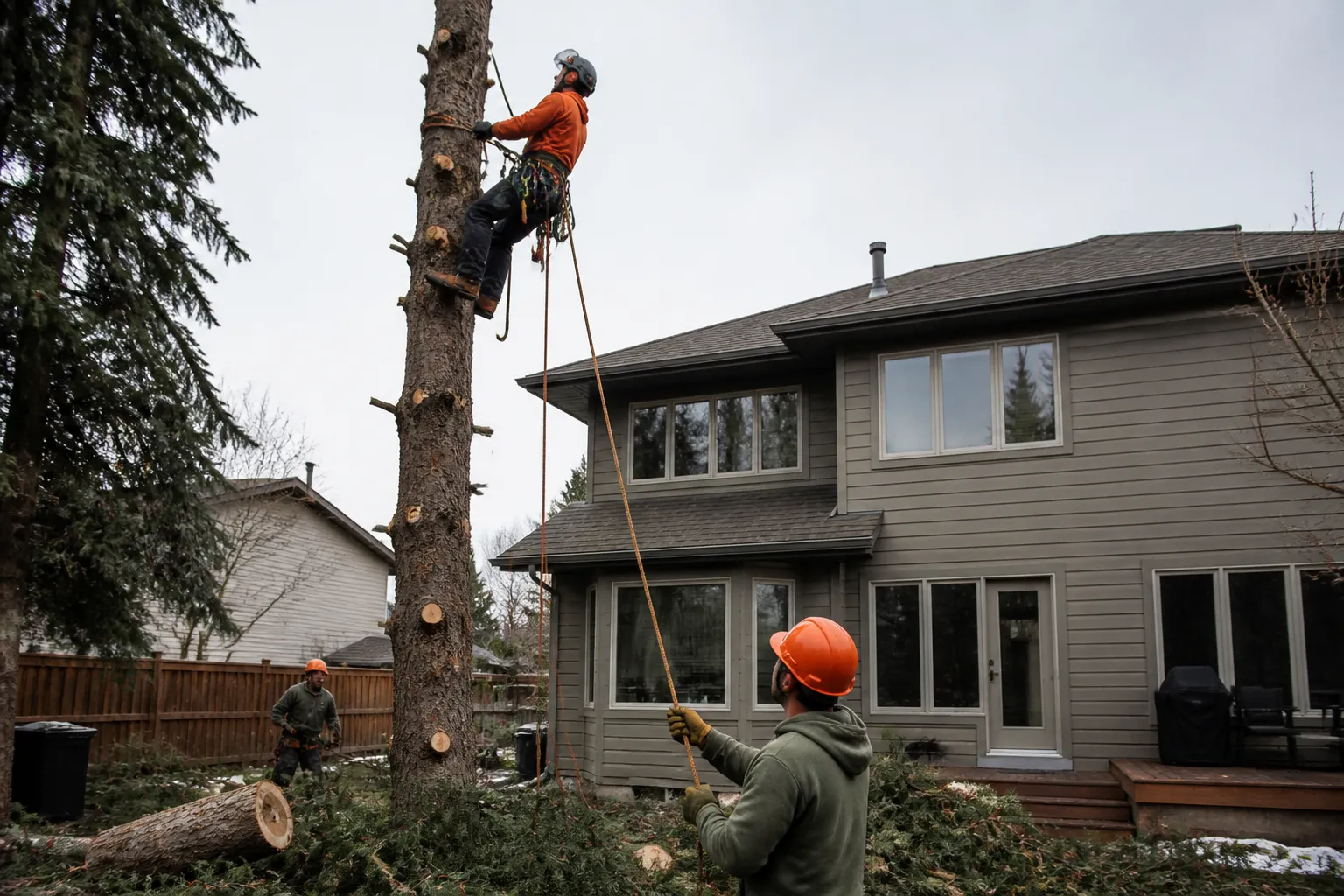
For trees that cannot be dropped whole, we remove the canopy and trunk in controlled sections. This often involves climbing systems, arborist ropes, lowering devices, tag lines, and rigging to manage each piece as it comes down.
When the site allows it, a tree may be felled in a planned direction. That approach relies on careful assessment of the lean, hinge control, weight distribution, and clear landing space so the tree lands where intended.
Large trees over homes, garages, or tight access areas may call for crane-assisted removal. In those cases, the work can involve lift planning, rigging points, slings, boom reach, working radius, suspended sections, and coordinated ground crews to remove the tree piece by piece with control.
Before any cutting starts, we review the tree from the root flare to the canopy. That means looking at the trunk, scaffold branches, branch unions, root zone, and nearby targets. A careful assessment helps determine whether removal is the right step and how to carry it out with the least disruption.
Tree removal is more than cutting the trunk down. The work usually includes planning, cutting, lowering, cleanup, and managing the material left behind. We aim to keep the site organized during the job so the property remains protected as work progresses.
For many properties, the goal is not just to take the tree out, but to leave the area ready for the next step, whether that means new planting, landscape changes, or a clear work zone.
Tree removal requests across Edmonton often involve species and conditions that need careful judgment. American elm, green ash, Manitoba maple, trembling aspen, balsam poplar, spruce, pine, birch, crabapple, and mountain ash each present different growth habits and structural issues. Some trees also show signs of disease, pest activity, drought stress, or damage from snow, freeze-thaw cycles, and wind events.
We also pay attention to issues such as Dutch elm disease, elm bark beetles, black knot, fungal pathogens, insect pests, bark abnormalities, canopy dieback, leaf loss, chlorosis, and split unions. If a tree shows a combination of decline and structural defects, removal may be the practical choice rather than continued decline management.
For boulevard or public trees, there may be additional requirements tied to City of Edmonton Urban Forestry and utility conflicts. If a tree sits near public space or shared infrastructure, the planning stage matters even more. We take those constraints into account before work begins.
Once the tree is down, the site still needs attention. Branches, stem wood, and debris must be handled in a way that leaves the property tidy and reduces obstacles for the next use of the space. We focus on clear material handling and careful movement around lawns, driveways, and hard surfaces.
If stump removal is part of the plan, stump grinding can eliminate the visible remains and make the area more usable. For property owners who plan to replant, we can also discuss tree planting after the old tree is removed and the site is ready.
Edmonton Tree Service handles removal work for a range of property types. That includes homeowners managing one hazardous backyard tree, businesses dealing with site access concerns, property managers needing coordinated tree work, and commercial properties with multiple trees that need to be cleared or reduced to match site plans.
Some removals are straightforward, while others involve tight access, occupied surroundings, or trees growing close to structures. We plan each job around the actual site conditions rather than forcing one method for every tree.
Look for major cracks, cavities, heavy lean, dead sections, root movement, or repeated branch drop. A tree with several warning signs should be assessed before it becomes a bigger problem.
Yes. Trees close to homes, garages, fences, and other structures are often removed by sectional dismantling or crane-assisted methods when the site calls for extra control.
Material is cut, moved, and cleared as part of the job. Depending on the tree and site, wood may be sectioned for handling and debris may be processed with chippers or loaded out.
Not always, but serious disease can weaken the tree, change how it stands, and affect nearby trees. We look at the extent of decline and the structural condition before recommending a path forward.
Yes. If a tree has outgrown the space, interferes with access, or creates repeated conflict with nearby structures, removal can be the practical solution.
It helps to know where the tree sits on the property, what it is affecting, and whether there are access limits, overhead conflicts, or nearby structures to protect. That gives us a clearer starting point for planning.
If a tree on your property needs to come out, the safest next move is a direct assessment and a removal plan matched to the site. Edmonton Tree Service works from Edmonton, Alberta T5H2S9 and serves surrounding communities including St. Albert, Spruce Grove, Fort Saskatchewan, Beaumont, Leduc, Stony Plain, and Morinville.
Call +16477005472 to discuss the tree, the location, and the access around it. We will help you determine the right removal method and the next steps for your property.
Get Started
Tell us what’s happening with your tree and property. Whether you’re dealing with storm damage, declining branches, a hazardous tree, stump removal or planned pruning, we’ll review the tree, site access and surrounding targets to help determine the appropriate next step.