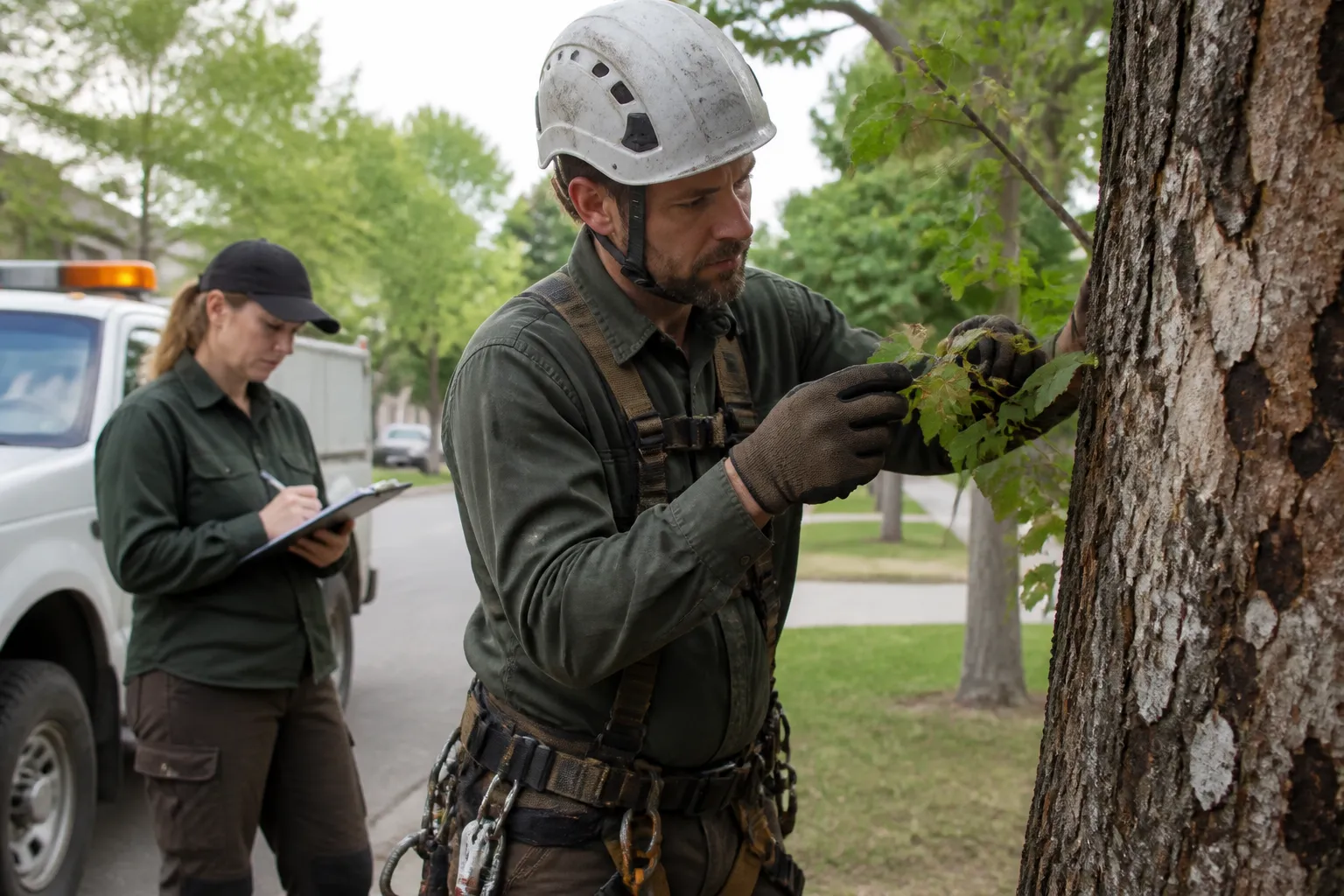
Leaves thinning out too early, branches dying back, bark changing shape, or a canopy that looks uneven can all point to more than seasonal stress. If you are noticing fungus on the trunk, insect activity, spots on leaves, or a tree that just does not look right, it is worth having it assessed before the decline spreads.
Edmonton Tree Service provides Tree Health, Disease & Pest Management for properties throughout Edmonton, Alberta T5H2S9. We look at the whole tree, from the root zone to the canopy, then recommend practical action based on what is causing the problem, how advanced it is, and what the tree may still be able to recover from.
Tree stress often shows up long before a branch breaks or the canopy fails. A careful visual assessment can help separate a temporary issue from a condition that needs treatment or removal planning.
When these symptoms appear, we assess whether the tree can be monitored, managed, pruned, treated, or should be considered for removal because of risk or advanced decline.
Edmonton Tree Service begins with a practical tree-health review that focuses on visible symptoms, site conditions, and tree structure. The goal is to identify the most likely cause rather than guessing from one sign alone.
We examine the trunk, scaffold branches, branch unions, canopy shape, and root flare to look for decay, cracks, included bark, co-dominant stems, and other structural concerns that can interact with disease or pest activity.
We also look at surrounding conditions such as soil compaction, root disturbance, shade patterns, recent construction impact, and target exposure. A tree under repeated stress can decline faster than a tree growing under stable conditions.
Leaf loss, chlorosis, cankers, abnormal sap flow, insect damage, or fungal growth are considered together. This helps separate a pest issue from disease, drought stress, or a larger root-zone problem.
Edmonton trees can face multiple stressors at once, and one issue can mask another. We pay close attention to the patterns that commonly affect local species and urban trees.
Local species such as American elm, green ash, Manitoba maple, trembling aspen, balsam poplar, spruce, pine, birch, crabapple, and mountain ash can each show different symptoms, so accurate identification matters.
Tree health work is not one-size-fits-all. The right response depends on the species, the symptom pattern, the extent of decline, and whether the tree is a good candidate for recovery.
Some trees can be stabilized and kept under observation. Others need intervention before decay or pest damage creates a larger hazard near homes, garages, fences, or walkways.
Tree health management around Edmonton, Alberta T5H2S9 often involves more than the tree itself. City requirements, utility conflicts, and species-specific concerns can affect what can be done and when.
Public trees and boulevard trees may require added care around access, clearance, and pruning restrictions. Elm-related work also needs special attention because certain pruning windows and disposal practices matter when disease pressure is part of the picture. We account for those conditions while planning work so the next step fits the tree and the site.
Commercial properties, managed landscapes, and shared spaces may also need a broader view of risk. A declining tree near parking areas, building entrances, or high-use spaces deserves a more careful evaluation than a low-target tree at the edge of a yard.
Tree health issues can feel vague at first, so a straightforward process helps. We keep the conversation focused on what is visible now and what should happen next.
That process gives property owners a clear next step instead of waiting for the decline to become obvious from the street.
Not every tree with symptoms needs the same response. A mature spruce with localized deadwood is different from a leaning ash with root disturbance or an elm showing signs of disease. We look at the tree’s structure, target exposure, and overall condition before recommending a course of action.
This approach is especially useful when a tree has value to the property but also shows signs of stress. In some cases, pruning and support can reduce strain. In others, a tree may need to come out before disease, decay, or structural weakness creates a larger problem.
Edmonton Tree Service works with homeowners, property managers, businesses, and commercial properties that need practical, site-specific tree care rather than a generic treatment plan.
Call when you see thinning foliage, dead branches, bark splits, fungal growth, insect activity, unusual leaning, or sudden changes in leaf color or retention.
Some trees can improve if the issue is caught early and the cause is manageable. Recovery depends on the species, the extent of damage, and whether the root system and trunk are still sound.
No. Some insect activity is minor, while other infestations can be a sign that the tree is already weakened. We look at the level of activity and the tree’s overall condition.
The root zone supports water uptake, stability, and nutrient movement. Disturbance, compaction, or decay there can affect the entire tree, even if the canopy still looks partly normal.
One-sided decline can point to localized root damage, stem injury, branch failure, or a problem that is affecting only part of the tree. It should still be checked carefully.
Some diseases and pests can move between trees, while others are more site-specific. An assessment helps identify whether nearby trees should be monitored as well.
If a tree on your property is showing signs of decline, getting it looked at early can make the difference between manageable care and more serious damage. Edmonton Tree Service provides Tree Health, Disease & Pest Management for properties at 10967 101 Street, Edmonton, Alberta T5H2S9 and across the surrounding area.
Call +16477005472 to schedule a visit and get a clear read on what your tree needs next.
Get Started
Tell us what’s happening with your tree and property. Whether you’re dealing with storm damage, declining branches, a hazardous tree, stump removal or planned pruning, we’ll review the tree, site access and surrounding targets to help determine the appropriate next step.