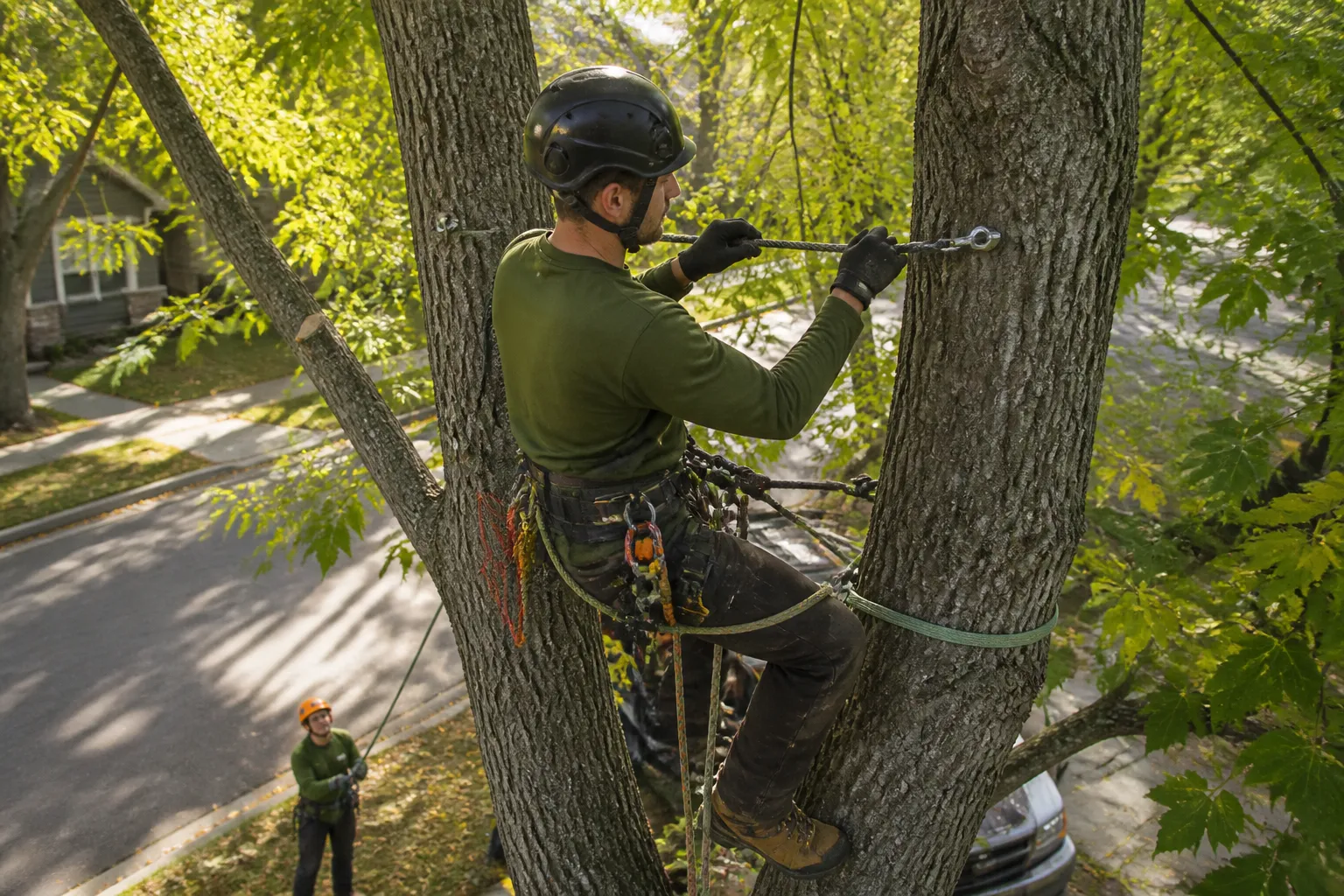
A tree with a heavy limb, a split trunk, or a wide leaning crown can look stable until the next wind event or snow load changes the picture. If you are noticing movement at a branch union, cracking at the trunk, or a canopy that seems too heavy for the structure beneath it, tree cabling and bracing may be worth a closer look.
Edmonton Tree Service helps property owners at 10967 101 Street, Edmonton, Alberta T5H2S9 decide whether support hardware can reduce stress on a tree and lower the chance of structural failure. We assess the canopy, trunk, scaffold branches, unions, and root zone, then recommend a practical support approach for the tree and the site around it.
Tree cabling and bracing is used when a tree has structural concerns that do not always require removal. The goal is to support weak attachment points, reduce movement between major limbs, and help the tree carry load with less strain on vulnerable areas.
We commonly look at mature trees with a split stem, codominant trunks, a heavy lateral limb, or a broad canopy that places force on a narrow union. In some cases, support hardware can help preserve a valued tree while lowering the chance of sudden branch failure.
Not every tree with one of these symptoms needs cabling or bracing. Some trees are better served with pruning, risk reduction, or removal. The value of an inspection is knowing which option matches the condition of the tree.
Support systems are chosen based on how the tree is built, where the weakness sits, and what the target area below looks like. A cable can help limit excessive sway between major limbs, while a brace rod can reinforce a split or a weak union from within the structure.
Edmonton Tree Service looks at the whole tree before recommending hardware. That means checking the root flare, root zone, trunk, scaffold branches, branch unions, and canopy shape, then deciding whether support will reduce risk without placing added stress elsewhere.
Cabling uses a flexible support line installed to limit how far a limb or stem can move. It is often considered when two major stems share load unevenly or when a long limb needs help during heavy wind or snow.
Bracing uses rods or other reinforcement methods to stabilize a cracked stem, split union, or weakened attachment. It is generally used where the tree needs more direct structural support than cabling alone can provide.
Some species and forms are more likely to develop structural concerns as they mature. In Edmonton, we often evaluate American elm, green ash, Manitoba maple, trembling aspen, balsam poplar, spruce, pine, birch, crabapple, and mountain ash when load distribution or branch structure becomes a concern.
The tree species matters, but structure matters more. A healthy tree can still have a weak union, and a stressed tree can sometimes be supported if the damage is localized. The question is whether the trunk and major limbs can safely carry the load with assistance.
Older trees often develop broad canopies and heavy limbs that place more stress on branch unions.
Codominant stems can separate over time, especially when bark is trapped between the stems.
When a tree grows over a structure or high-use area, support can be part of a larger risk reduction plan.
Before any hardware is installed, the tree needs a careful structural review. We look for decay, cavities, cracks, abnormal lean, root-plate movement, included bark, weak attachment angles, and signs of past failure. We also consider whether pruning can reduce load before cabling or bracing is added.
For some trees, the best result comes from a combination of selective pruning and structural support. For others, the condition of the stem or roots means support would not address the real problem. A clear inspection helps avoid adding hardware where the tree cannot benefit from it.
Tree health matters here too. Disease, pests, drought stress, and root disturbance can affect how much structural support a tree can reasonably carry.
When cabling or bracing is the right fit, the hardware is placed to support the specific weakness without changing the tree more than necessary. The layout must match the form of the tree, because poor placement can shift stress instead of reducing it.
Edmonton Tree Service plans the work around the branch union, trunk size, canopy reach, and site constraints. For larger trees, access and working space matter just as much as the support system itself. The goal is to reinforce the structure while respecting how the tree grows and moves.
We inspect the tree and confirm whether support is appropriate.
Selective pruning may be used to reduce excess weight before hardware is added.
Cables, braces, or both are installed based on the weak point and canopy structure.
We check alignment, movement, and the condition of the surrounding site.
For trees with major structural issues, support is not a substitute for sound judgment. Sometimes the honest answer is that the tree has reached a point where removal is the safer option. We explain that clearly when it applies.
Support hardware has limits. If decay is advanced, if the trunk is hollowed beyond a workable level, if the root zone is compromised, or if the tree has already failed in a major way, cabling and bracing may not provide enough value.
Other conditions can also change the recommendation. A tree affected by Dutch elm disease, severe pest pressure, or widespread dieback may be too weakened to rely on for long-term support. In those cases, the better plan may be tree removal, stump grinding, or a combination of tree health and risk management services.
That is why a site-specific assessment matters more than a quick visual guess. The right answer depends on the structure of the tree, the condition of the wood, and the level of risk around it.
Tree cabling and bracing is useful on many Edmonton properties, from private yards to managed landscapes. We work with homeowners, businesses, property managers, and commercial properties that need a practical answer for a tree with structural concerns.
It is especially useful where a mature tree still adds value to the property but needs support to remain a reasonable part of the landscape. It can also be part of a broader care plan that includes tree pruning, tree risk assessment, tree planting, or commercial tree services when a property has several trees with different needs.
Look for cracks, split unions, heavy limbs, repeated movement, or stems that appear to compete for dominance. A structural assessment is the clearest way to tell whether support could help.
Sometimes it can help if the damage is localized and the remaining structure is sound. If the problem is widespread decay or root failure, support is usually not enough.
No. Some trees only need cabling, some only need bracing, and some do better with pruning alone. The method should match the exact weakness.
It can be discreet, but there may still be visible hardware depending on the tree and the support needed. The setup is chosen for function first, with appearance considered during planning.
It may, if the split is stable enough and the rest of the structure is sound. A split that continues to open or shows significant decay may point toward a different solution.
No. Smaller trees with weak unions or poor structure can also benefit when the problem is localized and the canopy load can be managed.
If a tree on your property looks strained, unbalanced, or split at a major union, Edmonton Tree Service can evaluate whether cabling or bracing is the right next step for Edmonton, Alberta T5H2S9. We provide straightforward recommendations based on the tree’s structure, the condition of the wood, and what sits below the canopy.
Call +16477005472 to arrange a visit and get a clear plan for the tree you are trying to keep safe.
Get Started
Tell us what’s happening with your tree and property. Whether you’re dealing with storm damage, declining branches, a hazardous tree, stump removal or planned pruning, we’ll review the tree, site access and surrounding targets to help determine the appropriate next step.