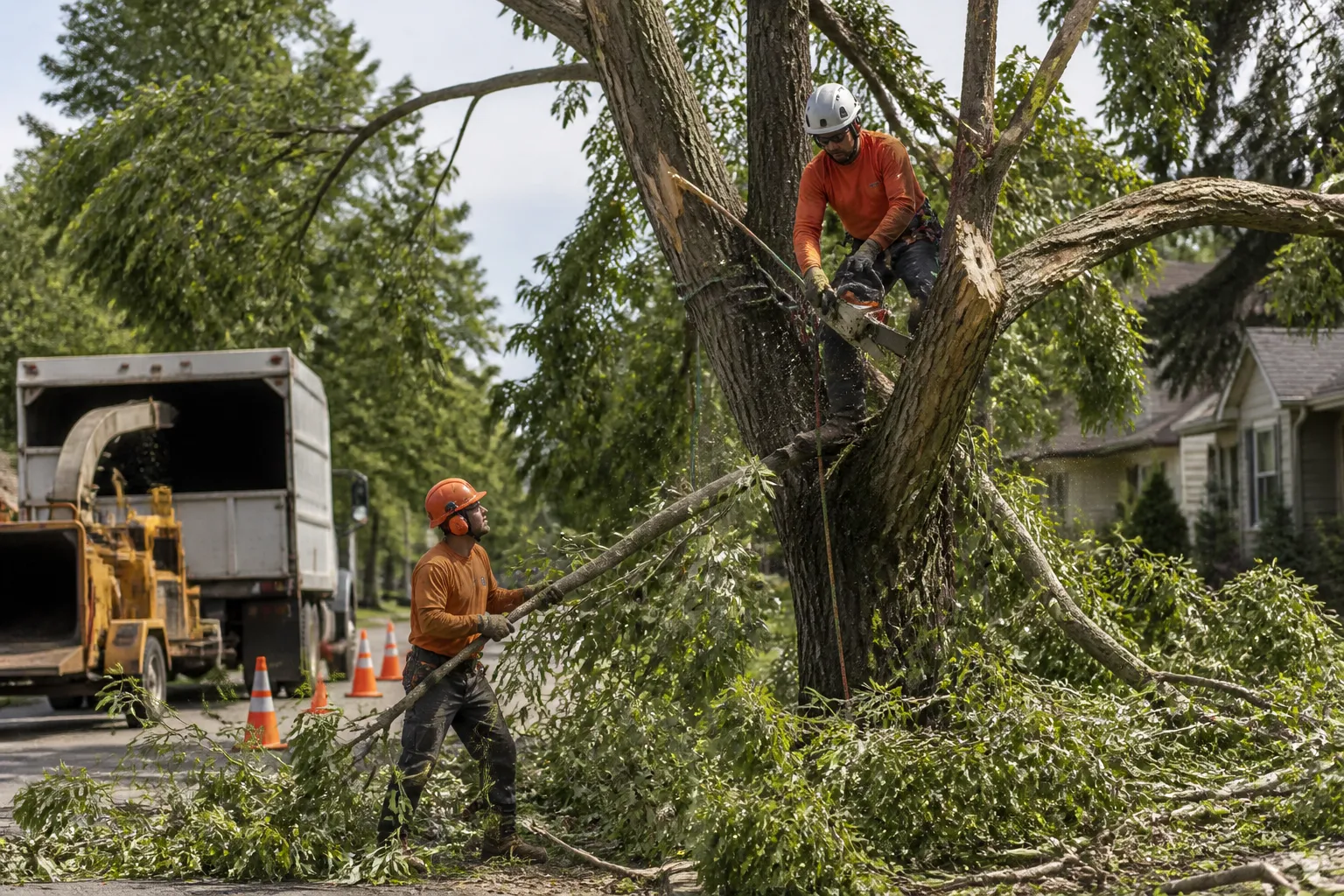
A tree split by wind, a heavy limb hanging over the driveway, or a trunk leaning against a structure needs immediate attention. If you are dealing with broken branches, root lift, or debris blocking access at your property, the safest next step is to keep people clear and call for a removal plan.
Edmonton Tree Service handles urgent tree removals and storm damage cleanup across Edmonton, Alberta T5H2S9, with work planned around the hazards on site. We assess the tree, identify what can fail next, and choose the method that fits the structure, the space, and the level of damage.
After wind, heavy snow, or a sudden shift in temperature, tree damage is not always obvious from the ground. A branch can look stable while a cracked union or torn bark still holds it in place. A trunk may also remain upright while roots have lifted on one side.
Watch for these warning signs before getting too close:
If a tree is near a structure or utility conflict, treat it as unstable until a visual assessment is completed. A branch that has shifted once can move again with vibration, wind, or additional load.
Not every storm-damaged tree needs the same approach. Some trees can be reduced section by section, while others require full removal because the stem, crown, or roots have been compromised. Edmonton Tree Service looks at the full structure before choosing how the work should proceed.
We also handle trees affected by decay, cavities, or included bark that become more unstable after weather stress. When the tree still has value but one section has failed, selective dismantling may reduce danger while protecting surrounding property.
Storm damage work often requires controlled tree removal rather than a single cut. The right method depends on height, stem condition, target areas, and available drop zone. On tight sites, the plan may involve rigging and lowering each section so the tree comes down in a controlled sequence.
For larger storm failures, crane-assisted removal can involve lift planning, rigging points, slings, suspended sections, boom reach, working radius, controlled picks, and coordinated ground crews. That approach can reduce contact with the structure below when the tree cannot be safely dismantled by standard means alone.
Storm cleanup is not only about removing wood. It is also about protecting what remains on the property while the damaged tree comes down. Broken stems can shift, bark can peel, and limbs can bounce or roll after release. Those risks increase around roofs, windows, vehicles, and hard surfaces.
Before cutting begins, we consider the drop path, nearby targets, access for equipment, and where debris will be staged. That planning helps limit secondary damage and keeps the work organized from start to finish.
If the tree is resting on a structure, we avoid forcing movement without a plan. Tension can release suddenly, so the sequence of cuts matters as much as the cuts themselves.
After the unstable parts are removed, the site still needs a cleanup plan. Storm damage often leaves behind long brush, broken trunk sections, scattered limbs, and wood that is too heavy to move by hand. We manage debris so the property can be used again without leaving hidden hazards behind.
Cleanup may include chipping brush, cutting larger wood into manageable sections, and clearing the area around the base of the tree. If a stump remains after the removal, stump grinding and removal can be scheduled separately to finish the job.
For properties with ongoing tree-care needs, we can also look at nearby trees for cracks, codominant stems, deadwood, or other conditions that may deserve attention after a storm event.
Not every storm-damaged tree has to come out right away. Some trees can be kept if the trunk is sound, the root zone is stable, and the remaining canopy still has good structure. A health assessment helps separate recoverable damage from a failure that is likely to worsen.
We consider symptoms and conditions such as canopy dieback, bark injury, fungal fruiting bodies, root disturbance, abnormal lean, and branch loss. In Edmonton, trees may already be under stress from drought, soil compaction, freeze-thaw cycles, heavy snow, wind events, insect pests, or disease pressure. That context matters when deciding whether pruning, support work, or removal makes the most sense.
When appropriate, tree cabling and bracing can be discussed for trees that still have structural value but need support after damage. If the tree has disease or pest concerns as well, management options are reviewed before the work moves forward.
Edmonton properties often include mature species such as American elm, green ash, Manitoba maple, trembling aspen, balsam poplar, spruce, pine, birch, crabapple, and mountain ash. Each species can fail differently under storm stress, and the removal plan should reflect the way the stem, branches, and root system are built.
Public-tree requirements, boulevard trees, elm-pruning restrictions, and utility conflicts can also affect how urgent work is handled. Edmonton Tree Service understands the practical side of those situations and plans the work around site conditions, access, and the tree’s location on the property.
When a large tree is too close to a structure, the safest approach is often a controlled dismantle rather than a pull-and-drop method. That is especially true when the canopy is tangled in other trees or when the root plate has already moved.
Keep clear of the tree, the branches, and any area where wood could shift. If the trunk or limbs are touching a structure, do not cut into it without a plan. Take a quick look from a safe distance and call Edmonton Tree Service at +16477005472.
Sometimes, but only if the structure is stable enough to remain a lower risk. A leaning trunk, split stem, or lifted root plate can change quickly. A site review helps determine whether removal, pruning, or support work is the safer choice.
Yes, hanging limbs can fail without warning. They may be lodged in the canopy, resting on another branch, or suspended over a target area. Those pieces should be treated as unstable until they are brought down in a controlled way.
We may use sectional dismantling, climbing systems, rigging, lowering devices, or crane-assisted removal depending on size and site layout. The aim is to remove the damaged wood without adding impact to the structure below.
That is common after severe weather. We separate unstable wood from loose debris, clear the working area, and remove the pieces in a sequence that keeps the site manageable. This also helps us see whether the tree base, trunk, or root zone has more hidden damage.
Yes. If one tree failed during a storm, neighboring trees may show cracks, deadwood, canopy loss, or root disturbance. We can look at adjacent trees and point out which ones need pruning, support, or further assessment.
If a storm has left you with a broken tree, a leaning trunk, or limbs threatening your property, Edmonton Tree Service can help with a clear removal plan and cleanup work at Edmonton, Alberta T5H2S9. Reach us at +16477005472 or visit 10967 101 Street, Edmonton, Alberta T5H2S9 to get the work started.
Get Started
Tell us what’s happening with your tree and property. Whether you’re dealing with storm damage, declining branches, a hazardous tree, stump removal or planned pruning, we’ll review the tree, site access and surrounding targets to help determine the appropriate next step.