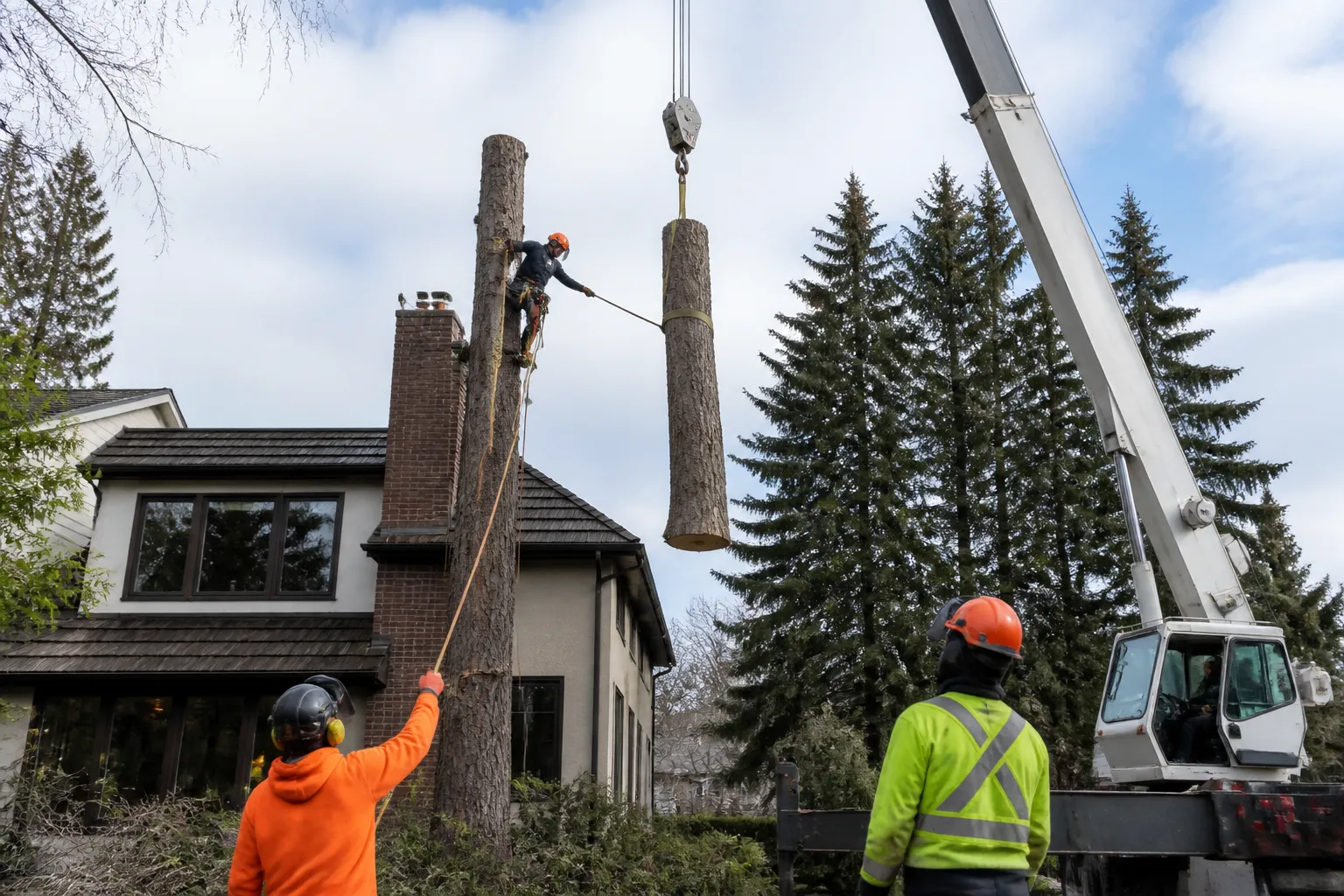
A tree that hangs over a garage, leans toward a house, or sits tight to another structure can quickly turn from manageable to difficult. When the tree is too large for simple ground-based removal, crane assistance gives the crew a controlled way to lift sections away without dropping them through the canopy or across the property.
Edmonton Tree Service handles crane-assisted tree removal for properties across Edmonton, Alberta T5H2S9 when the site calls for careful lifting, coordinated rigging, and a clean ground plan. If the tree has limited access, awkward lean, heavy limbs, or a location that makes sectional removal risky, this service is often the practical next step.
Not every tree needs a crane, but some trees demand a different approach from the start. When a large trunk or major limbs sit above homes, garages, fences, decks, or utility-conflicted spaces, lifting sections by crane can reduce the amount of cutting, dragging, and repositioning around the property.
We look at the tree, the drop zone, and the access route together. Crane-assisted removal is often considered when:
This method is not about using a crane for every job. It is about matching the removal method to the tree’s size, position, and condition so the work stays controlled from the first cut to the final cleanup.
Crane-assisted removal starts long before the first lift. At Edmonton Tree Service, we review how the tree stands, where each section can be cut, where the crane can reach, and how the ground crew will receive and process the lifted pieces. The job is mapped around the tree’s structure, nearby targets, and the site’s working room.
We evaluate the tree’s height, trunk form, branch spread, and nearby obstacles. A tall tree with heavy limbs may need different lift points than a tree with a narrow crown or a split stem. We also look at the root zone and the area around the base so the removal can be planned around safe footing and clear work paths.
Each section has to be sized for the crane, the rigging, and the available reach. Lift planning considers working radius, boom position, rigging points, sling placement, and how the piece will travel once it leaves the tree. The goal is to move each section cleanly and predictably rather than forcing cuts that are too large or awkward to control.
The ground crew stays tied into the plan from start to finish. That includes setting the landing area, managing cut wood, and keeping the site organized so the lifted pieces can be lowered, detached, and processed without crowding the work zone.
Crane-assisted tree removal is usually a sectional process. The tree is taken down piece by piece, with the crane supporting the removed sections while the arborist crew makes the cuts. That approach is useful for trees that cannot safely be brought down whole.
For certain large trees, the sequence may involve climbing systems, arborist ropes, lowering devices, tag lines, chainsaws, and coordinated rigging rather than relying on a single cut or a single lift. The method changes with the tree, not the other way around.
Crane-assisted tree removal is often the right fit for mature trees with large stems, wide canopies, or structural problems that make traditional handling too limiting. It can also help when a tree is healthy but simply too large or too awkwardly placed for a standard removal plan.
In Edmonton, trees such as American elm, green ash, Manitoba maple, trembling aspen, balsam poplar, spruce, pine, birch, crabapple, and mountain ash may all present different removal challenges depending on their size and condition. A tall spruce may require different lift points than a broad Manitoba maple, while a brittle or damaged limb can change how the removal is sequenced.
The method is chosen for the actual tree on the property, not just for the species name. Trunk form, branch unions, root flare condition, and canopy spread all affect how the crane is used.
A crane-assisted removal is often selected to reduce unnecessary contact with the rest of the property. When sections are lifted clear rather than dragged through tight spaces, there is less chance of brushing against siding, shingling, fencing, or ornamental planting near the work area.
That said, protection still depends on planning. We account for nearby targets, the path each section will travel, and the space required for the crane and ground crew to work without crowding the site. If the tree sits close to a structure, the lifting sequence has to stay disciplined so the branch or stem piece never becomes a swinging hazard.
Debris management matters too. Once the major sections are removed, the remaining wood, brush, and cut material still have to be processed and cleared. A clean finish is part of the service, not an afterthought.
Before a crane removal is scheduled, the tree’s condition is reviewed so the work can reflect what the tree is actually doing. Some trees are removed because they are simply too large for the site, while others are removed because damage, disease, or structural weakness makes them unsafe to leave standing.
During assessment, we look for issues such as canopy dieback, chlorosis, leaf loss, bark abnormalities, fungal fruiting bodies, decay, cavities, cracks, abnormal lean, root-plate movement, and compromised limbs. We also consider the tree’s root zone and the surrounding soil condition, since root disturbance and compaction can affect stability.
Local tree stressors can include Dutch elm disease, elm bark beetles, black knot, fungal pathogens, insect pests, drought, heavy snow, freeze-thaw cycles, and severe wind events. When these factors are present, a crane-assisted removal may be the safer way to remove a tree with reduced structural reliability.
Once the upper sections are down, the work is not finished until the site is cleared. After the main stem and limbs are removed, the remaining material is cut, organized, and taken away from the work zone. Stump grinding and removal can also be part of the plan when the tree is being fully cleared from the property.
For property owners who want a straightforward finish, the practical value of crane-assisted removal is not only the lifting itself. It is the control it gives over the entire job, from the first section cut to the final cleanup pass. Edmonton Tree Service keeps that sequence tight so the property is left ready for the next step.
If the tree is large, awkwardly placed, or located above a structure, a crane may be the safest removal method. A site review helps determine whether sectional dismantling alone is enough or whether lifting support is needed.
Yes. In some cases, only the upper portion, a damaged stem, or a major limb needs to come out. The plan depends on the tree’s condition and the reason for removal.
The crane works with planned rigging points and slings to lift sections after they are cut. The tree is supported through the rigging setup, not by random contact.
Tight access is one of the main reasons crane-assisted removal is considered. The lift plan, crane position, and ground layout are adjusted to fit the site as safely as possible.
Yes. If a tree has disease, decay, or structural defects that make it unstable, crane-assisted removal can reduce handling risk during dismantling.
The removal includes processing and cleanup of the cut material. The exact handling sequence depends on the size of the tree and the site layout, but the aim is to clear the property once the work is complete.
If you have a large tree that sits too close to a structure, leans into a problem area, or needs a controlled dismantling plan, crane-assisted removal may be the right answer. Edmonton Tree Service serves Edmonton, Alberta T5H2S9 with practical tree removal planning for difficult sites and large trees that need careful handling.
Reach us at +16477005472 for crane-assisted tree removal and related tree care needs. We operate from 10967 101 Street, Edmonton, Alberta T5H2S9, and we work daily from 07:00 to 21:00.
Get Started
Tell us what’s happening with your tree and property. Whether you’re dealing with storm damage, declining branches, a hazardous tree, stump removal or planned pruning, we’ll review the tree, site access and surrounding targets to help determine the appropriate next step.