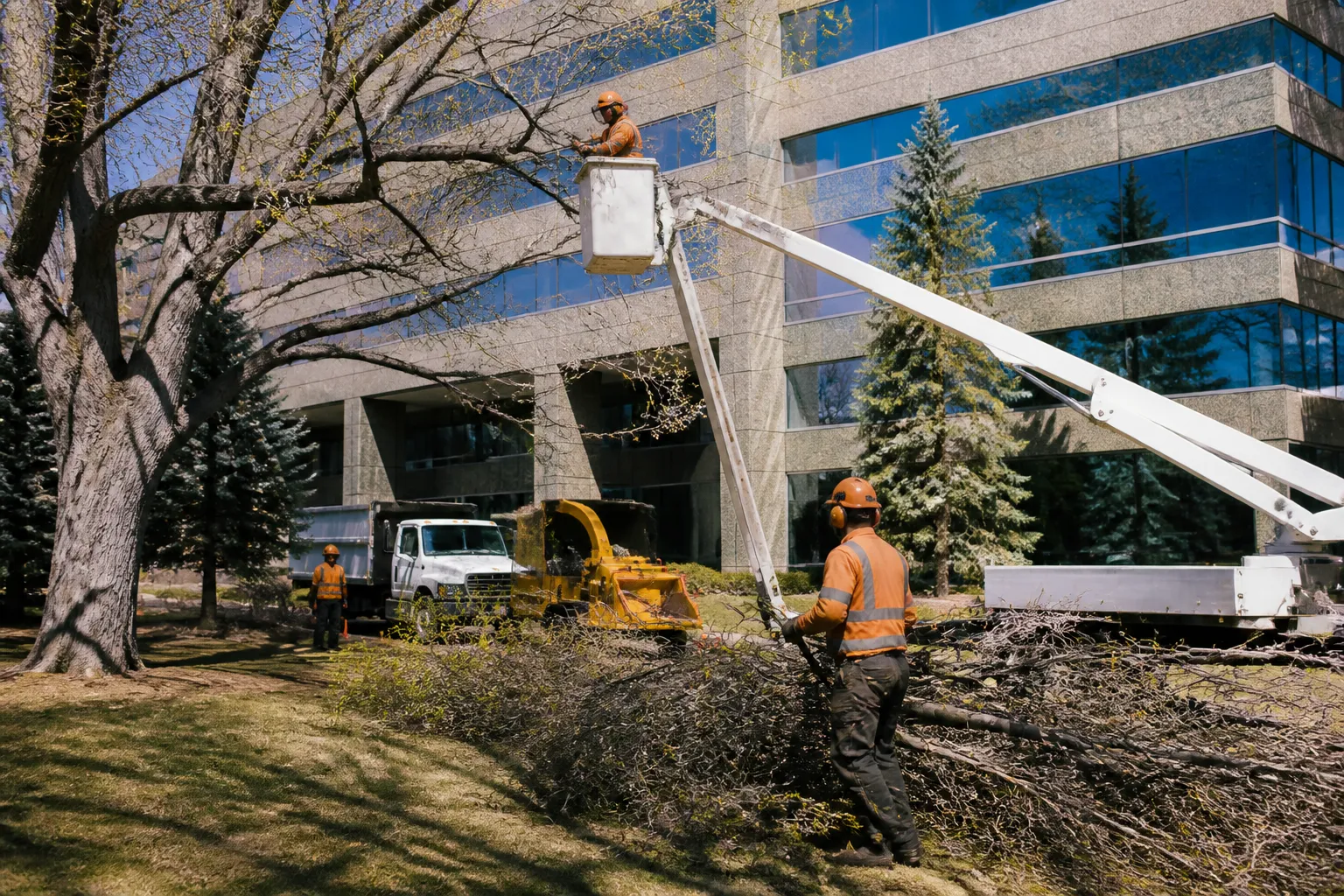
Overgrown trees can interfere with access, shade walkways, crowd structures, or create hazards across a business property. When branches reach too close to parking areas, loading zones, signs, or building lines, the work needs a careful plan that accounts for the site, the tree, and the people moving through it.
Edmonton Tree Service handles commercial tree services throughout Edmonton, Alberta T5H2S9 with pruning, removals, hazard assessment, stump work, and site clearing tailored to business properties, managed sites, and other larger landscapes. We look at how each tree sits on the property, what it affects, and what method will protect nearby structures, turf, access routes, and surrounding trees.
Commercial properties tend to have different tree problems than a backyard lot. A single limb can block signage, a leaning stem can threaten a structure, and roots can complicate grading, access lanes, or future planting areas. These concerns are not only visual. They affect safety, movement, and how the site presents to tenants, staff, customers, or visitors.
We regularly evaluate trees that sit near:
Commercial tree work often starts with identifying what the tree is doing to the site right now, then deciding whether pruning, cabling, removal, stump grinding, or planting is the more suitable path.
Tree removal on a commercial property can range from a straightforward drop zone to a controlled dismantle over structures or tight hardscape. Trees that are diseased, dead, storm-damaged, structurally weak, or too close to buildings may need to be removed piece by piece with rigging and lowering devices. On larger or more complex jobs, crane-assisted tree removal may be the more practical method when site conditions warrant it.
The method depends on size, access, lean, decay, targets below, and how much working room is available. We may use sectional dismantling, directional felling, climbing systems, arborist ropes, controlled rigging, tag lines, and wood chippers to manage the job with site protection in mind.
Cracks, cavities, deadwood, or decay can make a tree unsafe to leave standing near active areas.
If a tree leans over a building, vehicle area, or walkway, the consequences of failure are greater.
Some trees simply outgrow their location and create conflicts with access, utilities, or future site use.
Commercial pruning is often about more than appearance. It helps maintain clearance, reduce weight on strained limbs, improve structure, and address branches that interfere with daily use of the property. On mature trees, pruning may also reduce the chance of limb failure where the canopy has become crowded or uneven.
For commercial sites, pruning can address deadwood, crossing branches, crown structure, codominant stems, and included bark. It can also create better clearance over drive lanes, walkways, building edges, and landscape beds without overcutting the tree.
Not every tree that looks stressed needs to come down, but some need a closer look before a choice is made. Tree risk and hazard assessments help identify visible warning signs and determine whether a tree presents an unacceptable concern for the site.
We examine the tree’s structure from the root flare through the trunk, scaffold branches, branch unions, and canopy. That matters because failure can begin below grade, inside the trunk, or at a weak attachment point long before anything is obvious from a distance.
For commercial properties, the question is not only whether a tree is declining, but what it could affect if conditions worsen. That includes people, vehicles, structures, and the broader use of the site.
Wind, snow load, freeze-thaw cycles, and heavy moisture can all leave commercial trees broken, split, or partially uprooted. After a storm, a site may need damaged limbs removed, hanging branches brought down, debris cleared, and the remaining tree assessed for stability.
When branches have failed or a trunk has split, the goal is to restore safe access and determine whether the tree can remain with corrective work or should be removed. This may involve climbing systems, rigging, lowering devices, chainsaws, and chipping equipment to manage debris and open the site back up.
Storm work is especially important where broken limbs overhang parking areas, pathways, or building fronts, because those are high-use spaces with limited tolerance for uncertainty.
Commercial landscapes often include a mix of mature trees and ornamental plantings, which means tree health issues can spread or become more visible across a site. In Edmonton, Alberta T5H2S9, tree health concerns may involve Dutch elm disease, elm bark beetles, black knot, fungal pathogens, insect pests, drought stress, soil compaction, root disturbance, heavy snow, and severe wind events.
Tree health assessments look for symptoms such as canopy dieback, chlorosis, leaf loss, bark abnormalities, and fungal growth. From there, the next step may be pruning, cabling and bracing, selective removal, or a recommendation to monitor the tree more closely if the risk is limited.
Some commercial trees can stay on site with support. Cabling and bracing may help reduce movement in trees with structural weaknesses, codominant stems, or vulnerable branch unions. This is not a cure, but it can be a useful option when a tree has value and the structure still has enough integrity to justify support.
Tree planting is another important part of commercial site management, especially when a removed tree leaves a visible gap or when a property needs a more balanced landscape over time. New planting should account for mature size, root zone space, exposure, and how the tree will interact with nearby structures and site traffic.
Commercial jobs work best when the site conditions are understood before cutting begins. Edmonton Tree Service starts by reviewing the tree, the surrounding targets, and the access available for equipment and debris handling. From there, we plan the sequence of work so the job fits the property rather than forcing the property to fit the job.
For many commercial properties, that process includes:
We look at the tree, the targets below, and any access limits, utility conflicts, or canopy concerns.
We decide whether pruning, removal, cabling, stump grinding, or planting is the better fit.
We carry out the tree work with rigging, lowering, chipping, or crane-assisted removal when the situation calls for it.
Debris is removed so the site is left ready for normal use as much as the work allows.
Because commercial properties often have ongoing traffic and multiple stakeholders, clear communication matters just as much as the cut itself.
We work with business sites, property managers, and commercial landscapes that need tree removal, pruning, risk assessment, stump work, planting, or site clearing. The exact approach depends on how the trees interact with the property.
Yes. Pruning can create clearance over drive areas, paths, building edges, and other active parts of a site while also reducing weak or crowded growth.
It may be considered for larger trees over structures or for sites where access, reach, or rigging limitations make a crane the more workable option.
We look at tree condition, structure, location, and site targets. A tree with manageable defects may respond to pruning or support, while a tree with serious structural decline may be a stronger candidate for removal.
Stump grinding reduces the visible stump and helps clear the area for future use, though the surrounding ground still needs to be managed based on the site plan.
Yes. Many commercial jobs involve several trees at once, especially when the site has mixed health conditions, spacing issues, or a larger clearing objective.
Commercial tree services need a practical plan, not guesswork. Whether the goal is to remove a hazardous tree, open clearance around a building, assess a questionable trunk, or manage a larger landscape across Edmonton, Alberta T5H2S9, the work should match the site conditions and the tree’s actual state.
Contact Edmonton Tree Service at +16477005472 to discuss your property and the tree work it needs. Our address is 10967 101 Street, Edmonton, Alberta T5H2S9, and we provide commercial tree services for sites that need careful, organized tree care.
Get Started
Tell us what’s happening with your tree and property. Whether you’re dealing with storm damage, declining branches, a hazardous tree, stump removal or planned pruning, we’ll review the tree, site access and surrounding targets to help determine the appropriate next step.